text by Kevin Vaughn
Tell me how La Fermentadora got started.
All of this started because I began asking myself questions about my eating habits. I was beginning to eat more vegetarian but I didn’t know how to cook. I had to teach myself to cook and I really wanted to eat things that were different from what I had grown up eating. The food of my childhood was potato, lettuce, tomato. Not much else. So I started asking myself, What am I going to eat? What do I really want to eat? I needed to start incorporating legumes, vegetables and fruits into my diet. I started reading a lot, lots of YouTube videos, lots of new recipes and flavors for me, and I discovered my space in the kitchen. I was working at a law firm. I have a degree in International Relations (laughs). I was looking for something else. I didn’t like anything about working in an office. What brought on that change from eating meat to going vegetarian? I was feeling bad and knew that something I was eating was making me feel unwell. It was meat. It just doesn’t agree with me. Every time I ate meat it sat like a ball in my stomach. My digestion doesn’t process meat well. I’d spend hours feeling really uncomfortable while my body processed it. So I said, fine, I’m going to stop eating meat. First I gave up beef, then I stopped eating chicken, then I stopped eating ham. I started feeling better consuming other things but it wasn’t one day to the next. It was a long process of trying new things and slowly understanding that there were other things that I enjoyed eating.
I have a really hard time imagining you in a law firm! How did you start moving into food as a profession?
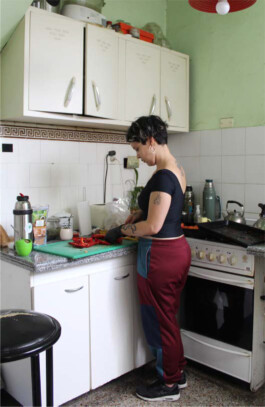
I didn’t want to work in an office. It was awful. I’d come home to my little kitchen and it was the only moment of my day that I really relaxed. A glass of wine. Cooking. That was my moment. When I was let go, I said no more: there was no way I was going to return to an office Downtown working nine hours a day. I started making vegan food from home and did that for a year in my tiny kitchen. It was very gradual, cooking and researching. I’d suddenly discover something like quinoa and that would lead me to another grain and that would lead to something else and over time as I incorporated more things to my diet the things I ate before weren’t as appealing. Selling out of my house was a lot of work and very unorganized and hard economically. I knew that I needed a foundation. I got a job at a health food store and have been there for five years. During all this I decided to quit and will stop working there later next month. How did you get started fermenting? I was working at the shop but was still cooking. I did catering gigs with friends. I knew that there was something there that ignited something inside me but I just couldn’t put my finger on it. I couldn’t find the direction. One day I came across an online class about fermentation. I did it at home and was like wow what is this? That’s how it started. I practiced. I made a million sauerkraut. Sauerkraut. Sauerkraut. Sauerkraut. Sauerkraut. I gave sauerkraut to everyone. All my friends. Everyone that came into the shop. It was like that for about a year and a half. I was going out with this guy and he said to me, Why aren’t you selling this? And I was like What?! Sell it? He was a graphic designer and made the label and I started to sell and do small productions with whatever free time I had. I’d make a batch, wait a month and when they were ready they’d sell out quickly. It was like that for maybe a year and half.
What is it about sauerkraut that does it for you?
There is something in the process that makes me feel good. I have a really difficult time focusing. I want everything now, everything quick. I’m always in the street, here and there, always moving. And with sauerkraut, I was suddenly dealing with something that took a month to make before I could try it. That was nuts to me. Preparing the sauerkraut is really quick and easy but to create the final flavor that I like, it takes a full month. There is something there that really pulls me in. And you don’t need a kitchen or a lot of money. Obviously after reading and learning about the nutritional aspects and the probiotics, that was wild for me, with so little you can make this really powerful food. And I can do it anywhere. It’s just cabbage, salt and your hands. And so I’d go to visit my sister in the United States and we fermented. I’d go to a friends house in the country and we’d ferment. It’s something that can be really easily shared. I started connecting with other people, building this little network. I always want to teach. People come over and I’m like, hey you want to learn to ferment? There is this really beautiful exchange that it allows that is the basis of ferments. It is this way of preserving food that has existed for thousands of years and it is passed from one generation to the next.
This project grew a lot during the pandemic, right?
When the quarantine happened, suddenly everyone was buying in bulk. And people wanted to buy my sauerkraut. Clients were buying double what they normally bought and I was running out of stock. I said to myself, I have to do something with this. Mariano is my roommate’s brother. He came to live with us and was out of work because of the pandemic. I asked him if he could help, he was down and so I taught him everything and we got started. We are making 100 kilos of cabbage a month and have now started experimenting with salsas and kimchis because we realized that we needed to be able to sell stuff that could be fermented quicker. And we are still running low. Everything we make sells. We never have leftovers of anything. We know that at some point we are going to have to rent a space and move out of here. I’d love to do it now but it requires a lot of money to get started that I don’t have. But I know it will come.

I think it is really opportune that we are talking about sauerkraut and fermentation as this way to preserve food, and to think of this moment that we are living in as a sort of fermentation. Like we are in the middle of the process getting ready to become sauerkraut. What would you like to preserve from the pre-pandemic world and what would you like to preserve from this moment and take into the future?
Speaking for me, a cycle has completed. I loved working at the shop. I know a lot of people because of that place. But I realized that what I need in this moment, for me, is to change the way I work. It’s not a moment for hierarchy and that dynamic of boss and employees. The pandemic brought that. The restaurant world, jeez, everything fell apart. It was really obvious what was going on but now it’s out in the open and clear that there were a lot of people that were not being protected by this system. For me, this has been a push forward in me genuinely seeing that I was destroying myself working so many hours and so many days and I had to say, wait a minute. For who? For how much? Why? If I can do all this for myself. I said, no, all this needs to go down this other path. Of course, this comes with a lot of fear too. It’s not easy to take that leap and leave a steady source of income which wasn’t much but it was there and bet on another quality of life based on doing what you enjoy. And I recognize that I am incredibly privileged to have this experience. I look around and I know there are so many people that are miserable right now, who don’t have enough work or have none at all. Everything is just one crisis after another for them and I’m over here like, wow I landed on the other side of the pandemic. I get to leave my house everyday, I have three times the work, more money. I mean, do we all realize that there are people sleeping in the street? There are people who don’t know what they are eating tomorrow. And there are also a lot of people out there helping too. Doing everything they can to help other people. So many things have happened in this and you’d have to be made out of stone to tell me that you haven’t had a moment of real reflection, like no way, it is impossible to not be touched by what is going on. The thing is whether we act on it or not.
Date
27.09.2020
Interviewer
Kevin Vaughn
Themes
Veganism
monthly & one-time options
Matambre Mag is a reader-funded fanzine and journal dedicated to exploring the socio-economic and political impacts of our food systems from the perspective of Buenos Aires and Argentina.
If you think work like this is valuable and would like to support local and independent journalism, please support with a monthly subscription beginning at just $2 a month.
monthly & one-time options
Matambre Mag is a reader-funded fanzine and journal dedicated to exploring the socio-economic and political impacts of our food systems from the perspective of Buenos Aires and Argentina.
If you think work like this is valuable and would like to support local and independent journalism, please support with a monthly subscription beginning at just $2 a month.
Designed by Metamensaje.
© 2024 All rights reserved.