On transcendence and the cuisine of the Argentine Mesopotamia
in conversation with Kevin Vaughn
We met one another in Buenos Aires and spent a lot of time cooking together in your restaurant and three years after its closure I’m still not over it, hence the name of this project. I remember when Matambre closed, you were feeling pulled back to Entre Ríos. What your childhood was like there?
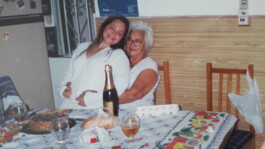
I was born in a small town in Santa Fe. My mother is Paraguayan. I would say that she was transferred to Santa Fe. When my grandfather died, my grandmother became a widow at a very young age in a chauvenistic society that wouldn’t let her work so she had to divide up her children. My mom was sent to a convent, one of her brother’s was sent to live with an aunt in the jungle, and so the family started breaking apart. My grandmother fell in love with a truck driver with Italian roots, got married and brought my mother from the convent to San Carlos in Santa Fe. My mom had some children with a Polish man, and when he passed away, she met my dad and had me. My grandma took care of us. That is sort of the role of Paraguayan grandmothers. The majority of women in Paraguay are housewives. Very few Paraguayan women work outside of the house even today. I was raised between the garden and chicken shed. I spent most of my childhood in my grandfather’s ice cream shop and the garden. I taught the chickens how to read, played games with them, they followed me everywhere like a mother hen.
During the school year, we lived with my parents in the city, and when we had vacation my mother would pack my bag and put me on a bus by myself, like from the time I was four years old, and I’d go to the country to stay with my grandmother. I have a lot of memories of like, weeds growing on the walls and my grandma would grab them and be like, this is arugula and I was fascinated. You mean, we can pull that weed off the wall and eat it? There were a lot of moments like that. My grandmother was the only one that had preserved the Paraguayan accent. It fascinated me because it was kind of forbidden. Here at home I couldn’t talk like a country girl because it was looked down on. I had friends that would tell me about their vacations on the beach and here I am teaching chickens to read.
Cooking was really natural to me. My grandmother would kill the chickens and we would pluck them, the feathers would be used to stuff a jacket or mattresses. We’d cut them open and clean the guts. I never developed an aseptic relationship with that. It didn’t gross me out. I had to do everything. I think that is where my love for gastronomy came from.
What did you eat at home and what did you eat at your grandmother’s house?
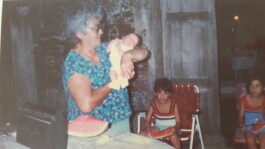
At my grandmother’s house, we ate whatever I wanted. She would wake me up in the morning with herb tea or with whatever weeds she found in the garden. Then the real breakfast would start. Milk with coffee and bread with homemade butter and she’d start asking me what I wanted to eat. My grandmother made a lot of soups, very nutritional food. She didn’t eat regional Paraguayan food even though that was who she was. A lot of stews. Very little meat. She cooked very vegetarian without really being aware of it, without putting a name on it, it was just what she had. I remember a lot of croquettes and buñuelos made with beet or sweet potato leaves or whatever leaves were in the garden.
At my parents house, well, my parents started working from a very young age. It was all the siblings that cooked. We ate experiments that got better over time. I remember my sister really liked Cuban rice and so we ate Cuban rice three nights in a row while she figured out how to make it. When my mother cooked, she cooked food with names. Now that I eat seasonally, I realized that when I have a craving it’s food with a name. Pastel de papa. Milanesa a la napolitana. When you eat seasonally, you eat what’s there, you eat food. At home when it was my turn to start cooking, I tried to imitate my mom’s cooking, food with names. I would draw menus and make people order food from me.
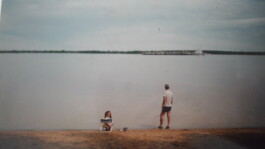
Jorgelina fishing with her father on the River Paraná
How did you end up in Buenos Aires?
As I got older, I realized that Paraná was too small for me. Limited opportunities. I was always the weird girl in Paraná. I studied theater and was interested in other stuff. When I got to the capital, I stopped being weird. I found myself amongst people that [sic] we felt very at home with one another. It was in the city that I started getting to know different food communities. I lived really close to Once and started trying food from different street stands without understanding anything I was eating. And when I would tell that to my family they wouldn’t get it. What? But you could be eating Italian food! But I was always really fascinated by food from different cultures. I started working in a cultural center and they put me in the kitchen and gave me the freedom to try things. That is when I started really opening myself up to a lot of questions I had about what we eat. I stayed in the kitchen because people kept telling me that was where I needed to be. I always felt kind of unsure, like I didn’t know enough because I hadn’t studied at the culinary institute, like what do I know? I knew a lot about soups and stews and understood how to build flavors that were influenced by my childhood.
We opened Matambre and I turned myself into a cook by force and with a desire to bring joy and share, and that was the experience that really cemented this path. You have to dedicate yourself to something, you know? I have spent the last 10 years cooking and experimenting. I have always felt a little like I don’t belong to this world and that I needed a title to do it but opportunities kept presenting themselves and with the freedom to be creative and over time I have felt more like a cook.
Around that time you were starting a culinary journey that had a lot to do with understanding your history. I think your Paraguayan and Mesopotamian roots was what were resonating with you the most. What does that mean for you? What makes up that Mesopotamian identity?
That changed over the years. I started to understand what it meant to be Paraguayan when I arrived in Buenos Aires. It really hit me because people couldn't imagine I had Guaraní blood because I am so white. And I remember thinking to myself, I couldn’t be more Argentine. I come from so many different places. I always saw myself that way. That Paraguay was just this part of me and I could be everything at once.
But I slowly started to feel like I was being pulled in a specific direction. I think that more than a country, we are from a region. I think a lot about the river. The river passes through so much. The Río de la Plata comes from Brazil. It touches the Amazons, it never returns to the same place, it gets stuck, it brings life. I feel like the river is a part of my body. Part of that transcendence is in me. Mesopotamia is humidity and heat. It’s nature and this sensation of growth. I feel like the river is a part of my body.
In Buenos Aires I really understood my connection to nature. We don’t see the river. We forget that it is there. We have this beautiful river and the city turns its back to it. That peace, that sense of pause, that is a part of me. Here we sleep the siesta. Here through the North [sic] Corrientes, Chaco, Formosa, Misiones, Santa Fe. You sleep the siesta. There aren’t businesses that are open all day long. There is a respect for the sensation of time. I’m going to stop what I’m doing, eat, let my food digest and rest. It’s not the best habit for capitalism but it gives life this space to be more present. That really started to speak to me.
You say that you didn’t connect with your Paraguayan heritage until you were older, what connection did you have with that part of yourself as a child?
I kind of imitated my grandmother. She was the only one that held on to her accent and I felt like a kid that speaks two different languages. When I was with her, it was just us and I latched onto that accent. I think as a little girl there was some jealousy or resentment towards me. I am very white so I was treated like I wasn’t really Paraguayan. I was raised without that part of myself. I always wanted to learn Guaraní and begged my grandmother to teach me but she refused. They distanced me from all of that culture that was inside us. Yesterday, I spoke with my mother and she told me that it is hard for her to hear me mimic a Paraguayan accent, which just comes out of me sometimes. When she arrived here people made fun of her. They asked her to speak so they could laugh at her. And so she would stand in front of the mirror and practice her Argentine accent. She lost a part of her essence.
As a little girl, I didn’t really understand that. I would get frustrated. I felt like I was being left out. As I got older, I started learning more about my food on the internet. Now I eat mbeju. But I tried it as an adult. I found a recipe online, I tried it, it was good and so I practiced and perfected my technique. One day, I took some to my parents’ house and they were like, how do you know how to make this? Now when I have to bring something over to eat, I make sopa paraguaya, which we never ate. It was a necessity to connect with something that was always inside me. I understand why it was rejected but that doesn’t make it any less a part of me.
There is a parallel in my own family. On my grandmother’s 80th birthday, my aunt made a video about her life. The title card started with her maiden name and there were friends of hers, women she'd known for four or five decades, who were like, Moovartian?! They all thought she was just some regular white lady. That was really shocking for me. Her parents escaped the genocide. They were poor farm workers and dealt with a lot of discrimination. And so my grandmother totally assimilated. She never spoke Armenian around us and didn't pass anything on to her kids or grandkids. How sad is that, that feeling that you have to change your whole identity? It's ironic because both the U.S. and Argentina are ‘country of immigrants,’ but clearly there are 'good' immigrants and 'bad' immigrants. What was that like for you, having the 'good' and 'bad' ancestry?
The immigration that happened over the last 100 years isn’t the same as what happened 200 years ago, which were a bunch of Europeans that came to colonize and occupy space to better their lives. As far as I understand, this nation was built by taking away the rights of the people who were here. This nation was created by erasing the native communities.
In the last 50 or 100 years, Paraguayans came to work, now they work a lot in construction. And so to put yourself in that role as a worker and the place they have on the social hierarchy [sic] it’s really capitalist to think of people as if we are part of a pyramid. There are people above and people below and the ones that are on the bottom need to stay there because that’s the hand they were dealt.
We’ve talked about this, you are a white male journalist from the United States, and so you get to come into spaces other immigrants don't. And to a certain degree, being white, the same thing happened to me. A lot of doors were opened that maybe if my complexion was different, I wouldn’t have ever been invited to occupy those spaces, like what happened to my grandparents.
[Editor’s note: the Mesopotamia is Argentina’s most biodiverse region, which covers three provinces across Northeast Argentina and thousands of native flora, fauna, birds, mammals and insects.]
We see this a lot in the food. Even though different Latin communities are very present in the city, they are either rejected and segregated or really exoticized. And within the narrative of Argentina, it is always talked about as a ‘country of immigrants’ but with this really extreme binary [sic] a simplified story that only talks about the immigration that happened up to the 1940s and everything that came afterward stays out of the narrative.
Yes and it’s not just a matter of negating immigration. It’s also a negation of what was already here inside Argentine territory. Before the War of the Triple Alliance, Paraguay reached Florianopolis and Corrientes. There is an entire section of Argentina that speaks Guaraní and not as a second language. There are other parts where Quechua is spoken too.
Where do you think that negation or editing of history comes from?
I think that it has to do with wanting what we don’t have, what we can never be, rather than wanting what is right here. In Paraná, it’s wild because there is native river fish, citrics, olives, regional cheese makers. Right now ,it’s pumpkin season and they are practically given away. There are artisans of all kinds. And the people don’t give a shit. People want, I don’t know, french fries with fake cheddar [sic] instagram food.
So instead of stopping on the side of the highway to buy danbo from a local cheese maker, they buy brie. That has a lot to do with there not existing a sense of nation. We watched 'Street Food' the other day. Why did they even go to Buenos Aires? Why do they always go to Buenos Aires? We are forgetting about all of the regions that have their idiosyncrasies and products that can only be consumed in that place.
In order for Paraná to start respecting or supporting a regional cuisine that is consumed by the masses, what are the challenges to get there?
There are thousands of challenges. Much of this has to do with access.
The other day my mom said to me, how do you think about all these things? And I said to her, even if you don’t think about this stuff doesn’t mean that they aren’t issues that affect you or that they are not a part of you. I think not having access to information is an injustice. I have access to an enormous amount of information that allows me to think and seek out alternatives. Maybe, for example, I’m reading about meat consumption and that opens the door to thinking about something else and something else. That ability to access or not, you see it in everything.
Here, there is a small movement of chefs making regional cuisine and they are all cooking with ingredients from Entre Ríos with French technique. What does one have to do with the other? Where is the regional knowledge? The closest that I have seen to eating from this earth is a place called Puerto Sánchez, which is a neighborhood of fishermen. They fish in the morning, set up tables at their front doors and sell whatever they caught that day. You start to see that each one has some little detail that makes their food unique. It’s really beautiful. But accessing that, that is partly a choice, too. I know that’s there because I am hungry for that information. Last year, my sister celebrated her birthday at this really shit snobby bar and ate a bunch of crap. This year, we went to eat fish at the port. I was so happy. It is those tiny decisions, we need more hunger for knowledge, curiosity, that everyone takes responsibility for that. Now, I live in a house that has three patios. I’ve returned to the garden, which my mother always associated with poverty, but for me it’s a moment of vindication.
Date
20.08.2020
Interviewer
Kevin Vaughn
Themes
Identity, Regionalism
monthly & one-time options
Matambre Mag is a reader-funded fanzine and journal dedicated to exploring the socio-economic and political impacts of our food systems from the perspective of Buenos Aires and Argentina.
If you think work like this is valuable and would like to support local and independent journalism, please support with a monthly subscription beginning at just $2 a month.


monthly & one-time options
Matambre Mag is a reader-funded fanzine and journal dedicated to exploring the socio-economic and political impacts of our food systems from the perspective of Buenos Aires and Argentina.
If you think work like this is valuable and would like to support local and independent journalism, please support with a monthly subscription beginning at just $2 a month.
Designed by Metamensaje.
© 2024 All rights reserved.